
In Chicago, rusting steel lintels are one of the most common — and most overlooked — causes of serious brick damage on older buildings. Every window and door opening in a brick building has a steel lintel holding the bricks above it. When that steel rusts, the bricks crack. When the bricks crack, water gets in. This page covers lintel, beam, and channel repair in Chicago — what these components do, how they fail, and exactly what repair involves. Casey Tuckpointing serves homeowners, landlords, and commercial building managers across Chicago and the surrounding suburbs. Contact us for a free on-site estimate.
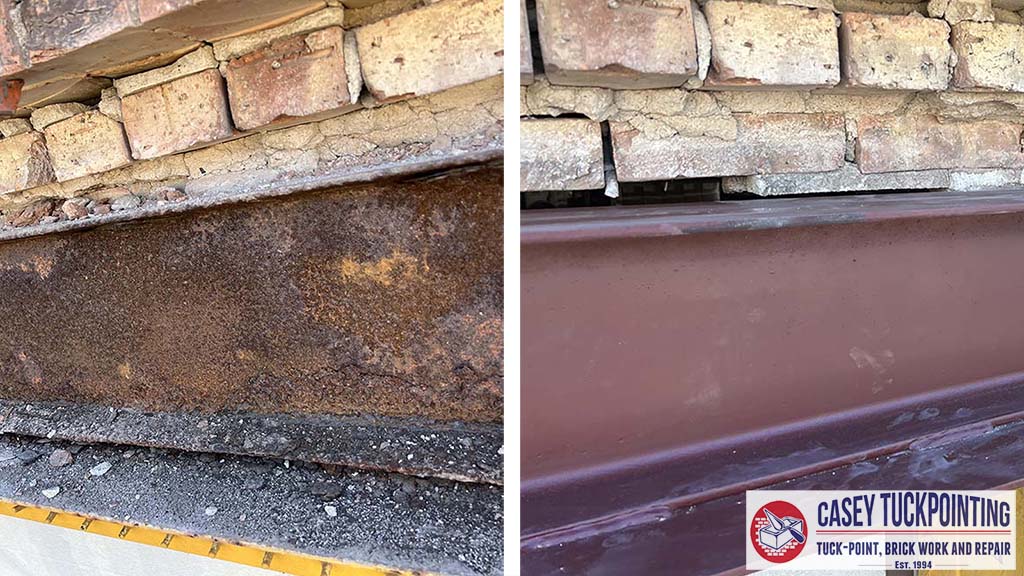
A Lintel Is the Steel Bar Holding Your Bricks Up Over Every Window and Door — and Chicago’s Climate Corrodes Them Fast
Most people never think about lintels until something goes wrong. That’s understandable — they’re hidden behind brickwork, doing a structural job that’s invisible until it fails.
Here’s what a lintel actually does: it spans the open space above a window or door and carries the weight of all the bricks above that opening. Without it, the bricks have nothing to rest on. The lintel transfers that load to the bricks on either side of the opening and down to the foundation.
In Chicago, most lintels are made of steel — and steel rusts. Salt air from Lake Michigan, high humidity in summer, and repeated freeze-thaw cycles in winter all accelerate corrosion. Many lintels on Chicago’s older brick buildings are original to the structure. A building from 1920 or 1940 may have lintels that have never been replaced — and they’re showing it.
Cracks Above Windows, Stair-Step Mortar Failures, and Rust Stains Are the Clearest Signs a Lintel Is Failing
You don’t need to see the steel to know a lintel is in trouble. The bricks and mortar around it tell the story first.
The most common warning signs on Chicago buildings:
Rust stains running down the brick face below a window. The steel is corroding and bleeding through the mortar joint.
Diagonal or stair-step cracks in the mortar joints above a window or door opening. The lintel is deflecting under load, and the brickwork above it is shifting.
Cracks running straight down from the corners of a window frame. The lintel has lost its bearing and the brick courses above it are separating.
Bricks that look pushed outward above an opening. Expanding rust is forcing the brick face away from the wall.
In neighborhoods like Irving Park, Jefferson Park, and across Chicago’s Northwest Side, brick two-flats and three-flats from the 1920s through the 1950s are especially prone to this pattern. These buildings often have one lintel per window opening — and a building with 20 windows may have 20 lintels approaching the end of their service life at the same time.
Catching lintel failure early means replacing one steel bar and rebuilding a few brick courses. Catching it late means rebuilding the entire window opening, the surrounding brickwork, and potentially the interior framing behind it.
A Failing Lintel in Chicago Can Trigger a Department of Buildings Violation — and a Safety Hazard
Lintel failure isn’t just a cosmetic problem. In Chicago, the Department of Buildings actively cites sagging or cracked masonry above window and door openings as a structural defect. It’s one of the most commonly issued masonry violations in the city.
When a lintel fails, bricks above the opening lose their support. In advanced cases, those bricks can shift, loosen, and eventually fall — onto sidewalks, stoops, or people below. Chicago takes that seriously, and inspectors are trained to spot the warning signs from the street.
For landlords, condo associations, and commercial building managers, a DOB citation comes with a deadline. The city expects documented proof of repair — not just a contractor’s word that the work was done. A licensed masonry contractor handles both the structural repair and the documentation, submitting everything needed to close out the violation in one project.
If you’ve received a citation or a notice from a city inspector, lintel repair is almost certainly part of the required scope. The sooner it’s addressed, the smaller the project stays.
Lintels, I-Beams, and C-Channels Do Different Structural Jobs — Knowing Which One You Have Changes the Repair
If you’ve gotten a repair quote and the contractor mentioned I-beams or C-channels alongside lintels, here’s what those terms mean and why they matter.
A lintel is typically a flat steel bar or angle iron installed above a residential window or door opening. It’s the most common type on Chicago brick homes and two-flats.
An I-beam is an H-shaped steel section used for larger spans — wide commercial openings, garage doors, or structural lintels carrying significant load. It’s stronger than a flat bar and used where the opening is wide or the load above it is heavy.
A C-channel (also called a channel or C-section) is a steel section shaped like the letter C. It’s common above storefront openings, in commercial and mixed-use buildings, and on older Chicago courtyard apartment buildings with large window groupings.
Each type has a different repair and replacement profile. A flat residential lintel is straightforward. A C-channel above a commercial storefront in a 1930s Chicago building may require temporary shoring, permit pulling, and a larger brick rebuild above the opening. A licensed mason identifies exactly which steel you have during the initial assessment — before any work begins.
The Lintel Repair and Replacement Process on a Chicago Brick Building — What to Expect
For owners in Ravenswood, Edgewater, or anywhere across Chicago who are ready to move forward, here’s what the full repair process looks like from start to finish.
Step 1 — On-site assessment. A licensed mason inspects every window and door opening on the exterior. Failed or at-risk lintels are identified and documented. You get a clear picture of the full scope before committing to anything.
Step 2 — Permit determination. Depending on the scope and building type, a Chicago building permit may be required before work begins. Your contractor makes that determination and handles the filing if needed.
Step 3 — Brick removal. The brick courses above the failing lintel are carefully removed and set aside. On well-executed jobs, the original bricks are reused wherever possible to maintain the look of the existing facade.
Step 4 — Temporary support. For larger openings or heavier loads, temporary shoring holds the structure above while the old steel is removed. This step is skipped for simple residential lintels but is standard on commercial and multi-unit work.
Step 5 — New steel installation. The old, corroded lintel is removed and replaced with a new galvanized or stainless steel lintel sized to match the original span and load requirements.
Step 6 — Flashing installation. New through-wall flashing is installed above the lintel before the bricks go back. This is the step that prevents the same corrosion cycle from starting over. More on this below.
Step 7 — Brick rebuild and tuckpointing. The brick courses above the opening are rebuilt with mortar matched to the existing wall. Joints are pointed and finished to blend with the surrounding facade.
Step 8 — Cleanup and documentation. The work area is cleaned, the repair is photographed, and documentation is prepared for city submission if a violation or permit was involved.
Most single-lintel replacements on residential buildings are completed in one day. Larger projects with multiple openings or permit requirements take longer — your contractor gives a firm timeline at the estimate stage.
Flashing and Waterproofing After Lintel Replacement Protect the Repair and the Bricks Above It
Replacing the lintel fixes the immediate structural problem. Installing proper flashing is what makes the repair last.
Through-wall flashing is a thin membrane installed horizontally above the new lintel, tucked into the mortar joint and extending out past the face of the brick. Its job is simple: any water that gets into the wall above the lintel hits the flashing and gets directed outward and down — away from the steel.
Without flashing, water follows the same path it always has, reaches the new steel, and the corrosion cycle begins again. In Chicago’s wet spring seasons and heavy lake-effect rain periods, missing or failed flashing above a lintel is the single most common reason a replaced lintel rusts again within a decade.
A complete lintel repair includes new steel and new flashing. If a contractor quotes you one without the other, ask why. On Chicago buildings, both are standard.
After the flashing is in place and the brickwork is rebuilt, an optional breathable waterproof sealer can be applied to the repaired section to provide an additional barrier against moisture infiltration — particularly useful on north-facing or heavily exposed facades.
Frequently Asked Questions About Lintel, Beam & Channel Repair in Chicago
How do I know if my Chicago building’s lintels need repair or full replacement?
If the steel is visibly rusted, bowed, or cracked — or if the bricks above a window are shifting or cracked in a stair-step pattern — replacement is usually required. A licensed mason confirms the condition and scope during a free on-site assessment.
What causes lintels to fail on Chicago brick buildings?
Steel rusts when water reaches it through failed mortar joints or missing flashing. The rust expands as it forms, cracking the surrounding brick from the inside. Over time the lintel deflects, loses its load-bearing capacity, and the brickwork above it begins to fail.
Can a failing lintel cause a Chicago building code violation?
Yes. The Chicago Department of Buildings cites sagging or cracked masonry above window and door openings as a structural defect. A licensed contractor repairs the lintel, documents the work, and submits it to the city to close out the citation.
What’s the difference between a lintel, an I-beam, and a C-channel?
All three carry load above openings but differ in shape and application. Flat lintels are standard on residential windows. I-beams handle wider or heavier spans. C-channels are common on commercial and courtyard buildings. A mason identifies which type your building uses during the initial inspection.
Do I need flashing installed when my lintel is replaced?
Yes — always. Through-wall flashing above the new lintel is essential to direct water away from the steel and prevent the same corrosion from recurring. A complete repair includes both new steel and new flashing.
How long does lintel replacement take on a Chicago building?
Most single-lintel replacements on residential buildings are completed in one day. Projects involving multiple openings, commercial buildings, or permit requirements take longer. Your contractor provides a firm timeline at the estimate stage.
Casey Tuckpointing — Masonry Service to Chicago and the Surrounding Suburbs. Contact us for a free estimate: (847) 962-6309 or info@caseytuckpointing.com